AI Psychosocial Evaluations
We measure the real-world impact of AI products, while shaping the public’s understanding of these harms.
The way technology is built is not a neutral or inevitable engineering outcome, but an active choice made by developers with profound consequences for each of us and society at large. CHT's Humane Product Design work addresses this on two fronts:
We measure the real-world impact of AI products, while shaping the public’s understanding of these harms.
We develop concrete design alternatives that product teams can build and policymakers can legislate.
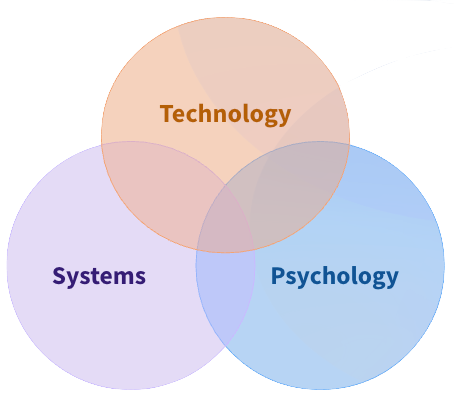
To build a technology that serves society, we need to account for three things:
Our Principles of Humane Technology, introduced below, offer a framework for integrating all three and building technology products that are more humane as a result.
Our Principles of Humane Technology offer a framework for building technology that serves society. These Principles are for anyone – not just technologists – to understand why certain interventions across culture, policy, and technology work better than others. Different aspects become feasible at different moments, and sometimes the most comprehensive solutions are hardest to implement. But when these Principles guide how technology is built and deployed, a clearer picture of genuinely humane tech emerges.
Our social, economic, and political systems are deeply interconnected. They have produced genuine progress and genuine tradeoffs. And each generation of technology accelerates this cycle, compressing the time to correct course. Humane technologists account for this by learning how complex systems behave, how incentives drive outcomes, how feedback loops amplify small shifts, and how unstated assumptions quietly shape what gets built, optimized, and left out.

Human flourishing depends on complex systems: cognitive and developmental capacities, shared understanding, democratic and legal institutions, and natural ecosystems. When technology products extract from these systems faster than they can recover (e.g., harvesting attention, fragmenting trust, or over-consuming ecological resources), they erode what all of us rely on. Humane technologists stay aware of how products deplete or regenerate these underlying systems, and address harms before the costs land on society.

Humane technologists develop a rigorous, well-considered definition of what genuine thriving looks like and use it to guide what they build. Without that foundation, products default to optimizing imitations (like engagement over genuine connection) that leave people worse off. Humane technology resists these false signals, and is designed to feel humane even to the most vulnerable person affected, ensuring that one group's flourishing doesn't come at another's hidden expense.

Every design choice prioritizes certain outcomes over others, whether product designers realize it or not. Humane technology rejects the fiction of neutrality: it makes the designer’s values explicit and uses them as guardrails. And it measures what truly matters for individual and societal flourishing, not just what's convenient to optimize.

Every technology creates social, economic, and political advantages for some people and disadvantages for others. AI and platforms often reshape these dynamics faster and more forcefully than institutions can respond. Two extremes emerge: concentrated power creates accountability gaps without checks and balances while spreading powerful tools without coordination or guardrails empowers malicious actors. Humane technology broadens access while avoiding catastrophic misuse, and builds oversight mechanisms that can keep up with rapidly advancing technologies.
Humane technology treats human psychology as a design constraint. Experiments that optimize for narrow metrics naturally reward designs that best exploit our weak spots, even if unintended. AI deepens this as it can deeply model and adapt to each person's specific vulnerabilities, making exploitation personalized and scalable. Technology should be responsive to human needs and respectful of human weaknesses, not engineered to override them.
Communities at every scale depend on shared understanding to coordinate and solve problems. Humane technology strengthens our ability to make sense of the world together, to agree and disagree constructively, and to maintain enough common ground to act on what matters
Our dual strategy cultivates an informed public and drives structural change through policy — two mutually reinforcing levers.
Our public awareness work surfaces emerging harms — from open-source exploitation to chaotic actors and runaway AI — helping people understand not just what’s happening, but why it matters. This builds the engaged constituencies needed for lasting political change. Our policy team tracks these risks closely and is poised to move quickly when the political moment ripens, knowing that the biggest threats often surface before the solutions are actionable. This dynamic loop ensures we stay ahead of accelerating harms while driving real, systemic change.
